
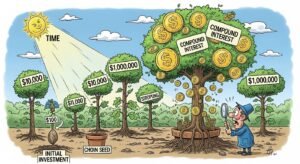
In the world of finance, there is a force so potent that Albert Einstein reportedly called it the “eighth wonder of the world.” That force is compound interest. While it may sound like a dry mathematical concept, the power of compound investing is the fundamental engine behind nearly every great fortune built in the modern era. To understand how to build a legacy, one must first master the selection of compound interest investments that allow capital to grow exponentially over time.
Whether you are a young professional just starting your career in New York, London, or Toronto, or someone looking to optimize a retirement investing strategy, understanding how to harness the exponential growth of your capital is the difference between struggling to save and achieving true financial independence. In this guide, we will break down the mechanics of compounding, compare it to short-term trading, identify the best vehicles for growth, and provide a roadmap for you to start building your wealth today.
1. What is Compound Investing?
At its simplest, compound interest is “interest on interest.” However, when applied to the stock market and various asset classes, we refer to it as compound investing. It is the process where the returns on your capital are reinvested to generate their own returns.
How Compound Interest Works
Unlike simple interest—where you only earn returns on your initial principal—compounding allows you to earn returns on your principal plus all the accumulated interest or capital gains from previous periods. When looking for compound interest investments, the goal is to find assets that provide consistent yields or growth that can be cycled back into the original position.
The Basic Formula:
A = P(1 + r/n)^(nt)
- A = the future value of the investment
- P = the principal investment amount
- r = the annual interest rate (decimal)
- n = the number of times interest compounds per year
- t = the number of years the money is invested
In a long-term investing strategy, the “n” (frequency) and “t” (time) are your greatest allies. The more frequently your returns are reinvested into your compound interest investments and the longer you leave them untouched, the steeper the growth curve becomes.
2. The Mathematical Magic: Visualizing 10 to 40 Years of Growth
To truly respect the power of compound investing, one must look at the numbers. Small, consistent contributions paired with time create results that are often counterintuitive to the human brain, which tends to think linearly rather than exponentially. Many beginners often ask, “what investment has compound interest?” The truth is that while “interest” is a banking term, the stock market mimics this behavior through the reinvestment of dividends and capital gains.
Case Study: The $500 Monthly Contribution
Imagine three investors: Alex (starts at 25), Beatriz (starts at 35), and Charlie (starts at 45). They each invest $500 per month into a diversified portfolio with an average annual return of 8%.
| Investor | Start Age | Total Invested (Principal) | Value at Age 65 |
| Alex | 25 | $240,000 | $1,554,339 |
| Beatriz | 35 | $180,000 | $684,592 |
| Charlie | 45 | $120,000 | $284,510 |
The Takeaway: By starting just 10 years earlier than Beatriz, Alex ended up with nearly $900,000 more, despite only contributing $60,000 more out of pocket. This demonstrates why the best compound interest investments are those held for the longest possible duration.
The Decades of Growth Breakdown
- 10 Years: In the first decade, your compound interest investments do the heavy lifting of building a base. If you invest $10,000 at 8%, you have $21,589.
- 20 Years: The curve starts to bend. That same $10,000 is now $46,610.
- 30 Years: This is where the “magic” happens. Your balance hits $100,626.
- 40 Years: The final decade shows the true power of the curve, ending at $217,245. Notice how the growth between year 30 and 40 is greater than the total value of the first 20 years combined.
3. Best Asset Types for Compound Growth
To maximize stock market compound returns, you must select assets that generate consistent internal growth or distributable cash flow that can be reinvested. When people ask “where to invest for compound interest,” they are usually looking for stability combined with high-yield potential.
Low-Cost Index Funds and ETFs
For most investors, a Broad-Market Index Fund is the gold standard. These are among the best compound interest investments because they offer:
- Diversification: Instant exposure to hundreds of companies.
- Low Fees: Expense ratios as low as 0.03% ensure more of your money stays in the “compounding machine.”
Dividend Growth Stocks
Dividend-paying stocks offer a “double-whammy” of compounding. If you are researching what investments have compound interest features, look specifically at “Dividend Aristocrats”—companies that have increased their dividends for at least 25 consecutive years. You benefit from share price appreciation and dividends that can be used to purchase more shares through Dividend Reinvestment Plans (DRIPs).
Real Estate Investment Trusts (REITs)
REITs are a unique answer to the question of where to invest for compound interest. By law, they must pay out 90% of their taxable income to shareholders. When you reinvest those high-yield dividends, the compounding effect can be massive, especially in tax-advantaged accounts.
4. Compound Investing vs. Short-Term Trading
Many retail investors are lured by the prospect of “beating the market” through day trading or swing trading. However, for the vast majority of people looking for passive income investing and wealth security, the long-term approach of holding compound interest investments is statistically superior.
The Trading Trap
Short-term trading requires constant market timing. If you miss just the 10 best-performing days in the stock market over a 20-year period, your total returns can be cut in half. By contrast, compound interest investments don’t require you to be right about the “when”—only the “what” and the “how long.”
The Compound Advantage
- Lower Transaction Costs: Frequent trading incurs commissions and spread costs that eat into your principal.
- Tax Efficiency: Long-term capital gains are generally taxed at a lower rate than short-term gains (especially in the US and Canada).
- Reduced Stress: You don’t need to monitor minute-by-minute fluctuations when your focus is on a 30-year horizon.
- Market Resilience: Compounding rewards “time in the market” rather than “timing the market.”
5. Wealth Building Strategies for Different Life Stages
The Young Investor (Ages 18–30)
- Priority: Time.
- Strategy: Maximize contributions to tax-advantaged accounts (401k/IRA in the US, RRSP/TFSA in Canada, ISA in the UK). Focus on aggressive growth assets (100% equities) as your compound interest investments.
- Action: Automate a monthly transfer to a brokerage account. Even $50 a month is enough to start the engine.
The Mid-Career Pivot (Ages 35–50)
- Priority: Catch-up and Optimization.
- Strategy: Increase your contribution frequency. As your salary increases, resist lifestyle creep and funnel those extra funds into compound interest investments.
- Action: Evaluate robo-advisors for automated rebalancing and tax-loss harvesting to keep your compounding efficient.
The Late Starter (Age 50+)
- Priority: Capital Preservation + Focused Growth.
- Strategy: You may not have 40 years, but you may have 20. Focus on high-yield, high-quality assets. Many people at this stage ask, “what investment has compound interest that is safe enough for me now?” The answer often lies in balanced funds or high-quality corporate bonds.
- Action: Utilize “catch-up contributions” allowed in many retirement plans to maximize the tax-free portion of your compounding.
6. Mistakes That Kill Compound Growth
The path to wealth is often sabotaged by human behavior rather than market performance. If you hold the right compound interest investments but make these mistakes, your growth will stall.
1. Frequent Withdrawals
Taking money out of your investment account “resets” the compounding clock. A $10,000 withdrawal at age 25 isn’t just $10,000; it’s potentially $150,000 of “future money” that will never exist.
2. High Management Fees
A 2% annual fee might seem small, but over 30 years, it can eat up nearly 40% of your total potential wealth. Always opt for low-cost investment platforms to ensure your compound interest investments are working for you, not your broker.
3. Ignoring Inflation
If your investment earns 5% but inflation is 4%, your real purchasing power is only growing by 1%. To combat this, you need compound interest investments that historically outpace inflation, such as equities and real estate.
4. Over-Diversification in Low-Yield Assets
While bonds have their place, being too conservative too early can cripple your growth. If you are looking for what investments have compound interest potential, you must accept a degree of volatility in exchange for the higher returns that drive exponential growth.
7. Deep Dive: Best Assets for Long-Term Wealth
When selecting your compound interest investments, you must look at the historical performance of different asset classes.
Exchange-Traded Funds (ETFs)
ETFs have revolutionized the way we access compound interest investments. By buying a single share of an ETF like VOO or SPY, you are effectively investing in 500 of the largest companies in the US. This “set it and forget it” approach is the cornerstone of modern wealth building.
Mutual Funds
While often eclipsed by ETFs, certain actively managed mutual funds still have a place. When people ask “what investments have compound interest?” they are often thinking of these traditional vehicles. The key is to find those with low turnover and a proven track record of outperforming their benchmarks over 10+ years.
Retirement Accounts
Your compound interest investments should live inside tax-advantaged shells whenever possible.
- Tax-Deferred Accounts: (Traditional IRA/401k) Your money grows without being taxed every year, allowing the government’s portion to compound for you in the meantime.
- Tax-Free Accounts: (Roth IRA/TFSA) You pay tax upfront, but the compounding and eventual withdrawals are 100% tax-free.
8. Common Investor Questions (Beginner to Advanced)
How do I find the best compound interest investments for a small budget?
The modern era of fractional shares means you can start with as little as $1. Look for apps that allow you to buy small slices of diversified ETFs.
Are there specific compound interest investments for retirement?
Target-date funds are specifically designed for this. They hold a mix of stocks and bonds that automatically shifts toward more conservative assets as you reach your retirement year, protecting the compound growth you’ve accumulated.
How does “reinvestment” actually happen?
In most brokerage accounts, you can toggle a setting called “DRIP” (Dividend Reinvestment Plan). This automatically uses any cash dividends paid by your compound interest investments to buy more shares of that same asset, often without any commission fees.
9. Actionable Steps to Start Today
- Audit Your Finances: Determine exactly how much you can afford to invest monthly. Consistency is the primary fuel for compound interest investments.
- Open a Retirement Account: Choose a reputable brokerage account or robo-advisor with low fees.
- Select Your Core Assets: If you are unsure where to invest for compound interest, a Total Stock Market Index Fund is a statistically sound place to start.
- Automate Everything: Set up a recurring deposit. This removes “decision fatigue” and prevents you from trying to time the market.
- Reinvest All Distributions: Ensure your account is set to automatically reinvest dividends and interest. This is the only way to turn a linear investment into compound interest investments.
10. Conclusion: The Psychology of the Long-Term Mindset
The hardest part of wealth building strategies is not the math—it’s the waiting. In the first few years, your compound interest investments will feel like they are moving at a snail’s pace. You might see your account grow from $10,000 to $11,000 and feel discouraged.
However, compounding is back-loaded. The most significant gains happen in the final third of your time horizon. Staying the course during market downturns and resisting the urge to “do something” is the hallmark of a successful investor.
The best time to start was 20 years ago. The second best time is today. Harness the power of compound investing, identify the compound interest investments that fit your risk profile, and let time do the heavy lifting for your financial future. Whether you are using investment platforms, high-yield accounts, or the stock market, the key is to stay invested and let the eighth wonder of the world work for you.
Frequently Asked Questions
How long does it take for compound interest to double your money?
You can use the “Rule of 72.” Divide 72 by your expected annual return. For example, at a 7% return, your money doubles approximately every 10.2 years ($72 / 7 = 10.2$).
Is compound investing risky?
All investing involves risk. However, a diversified long-term investing strategy historically mitigates risk over time. While the market fluctuates in the short term, the long-term trajectory of the global economy has historically been upward.
Can I start compound investing with only $100?
Yes. Many modern investment platforms offer fractional shares and have zero account minimums, making it easier than ever for beginners to start their journey with compound interest investments.