
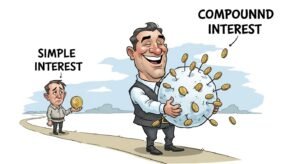
In the journey toward financial literacy, few concepts are as fundamental as the way money grows or how debt accumulates over time. Whether you are looking to grow a retirement nest egg or trying to pay off a student loan, the mechanism of interest will dictate your success. Understanding the nuances of simple interest vs compound interest is not merely an academic exercise; it is a critical skill that impacts your bank balance every single day.
For the average consumer, interest can either be a powerful tailwind or a devastating headwind. While one form of interest remains static, the other grows exponentially, creating vastly different outcomes over long horizons. In this guide, we will break down the mechanics of both systems, provide clear formulas, and explore real-world scenarios to help you master the debate of simple interest vs compound interest and apply it to your personal wealth strategy.
1. What is Simple Interest?
Simple interest is the most straightforward way to calculate the cost of borrowing or the return on an investment. It is calculated solely on the principal amount—the original sum of money borrowed or invested. It does not account for any interest that has accumulated in previous periods.
The Simple Interest Formula
To calculate simple interest, you use a basic linear equation:
$$I = P \times r \times t$$Where:
- I is the interest amount.
- P is the Principal (original amount).
- r is the annual interest rate (as a decimal).
- t is the time the money is borrowed or invested (in years).
Example of Simple Interest
Imagine you lend $10,000 to a friend at a 5% simple interest rate for three years. Each year, you earn $500 ($10,000 x 0.05). At the end of the three years, you have earned a total of $1,500 in interest. The principal remains the only basis for the calculation throughout the entire term. This linear growth is the hallmark of simple interest vs compound interest comparisons where the timeline is short.
2. What is Compound Interest?
Compound interest is often described as “interest on interest.” Unlike the simple version, compounding adds the interest earned in a specific period back into the principal balance. In the next period, interest is calculated on this new, larger total.
The Compound Interest Formula
The formula for compounding is more complex because it involves exponents to account for the accelerating growth:
A = P(1 + r/n)^(nt)
Where:
- A is the final amount (principal + interest).
- P is the Principal.
- r is the annual interest rate.
- n is the number of times interest is compounded per year.
- t is the number of years.
Example of Compound Interest
Using the same $10,000 at 5% but compounding annually for three years:
- Year 1: Interest is $500 (Total: $10,500).
- Year 2: Interest is calculated on $10,500, which is $525 (Total: $11,025).
- Year 3: Interest is calculated on $11,025, which is $551.25 (Total: $11,576.25).
In this short window, the difference in simple interest vs compound interest is only $76.25. However, as we will see, this gap widens into a chasm over decades.
3. Side-by-Side Comparison: Simple vs Compound
When evaluating simple vs compound interest, it helps to see the mechanical differences in a direct comparison. While compound vs simple interest discussions often focus on the “more is better” aspect for savers, borrowers must look at the “less is better” side.
| Feature | Simple Interest | Compound Interest |
| Basis of Calculation | Principal amount only | Principal + accumulated interest |
| Growth Rate | Linear (stays the same) | Exponential (accelerates) |
| Principal | Constant | Increases every compounding period |
| Common Use Cases | Short-term loans, car loans | Savings accounts, 401ks, credit cards |
| Wealth Impact | Predictable and steady | Massive long-term growth |
Choosing between simple vs compound interest depends entirely on which side of the transaction you are on. As a rule of thumb: you want to earn compound interest and pay simple interest.
4. How Interest Types Impact Savings and Investments
For the modern investor, the goal is to leverage the “eighth wonder of the world.” Most high-yield savings accounts and brokerage products utilize compounding. When you compare simple interest vs compound interest in a retirement context, the “simple” version is almost always inferior.
The Power of Frequency
In the world of compound interest vs simple interest, the frequency of compounding (daily, monthly, quarterly) acts as a multiplier. Daily compounding results in a higher Annual Percentage Yield (APY) than annual compounding, even if the nominal interest rate is identical. This is why savvy investors look for platforms that offer frequent compounding to maximize their returns.
5. How Interest Affects Loans and Debt
While compounding is a friend to the saver, it can be a formidable enemy to the debtor. Most credit cards utilize daily compound interest on unpaid balances. This is why credit card debt is so notoriously difficult to escape; you are literally paying interest on the interest you couldn’t pay last month.
Conversely, many personal loans and traditional auto loans use simple interest. In the simple interest vs compound interest battle for borrowers, simple interest is far more consumer-friendly. It makes the total cost of the loan transparent and predictable. If you have the option to choose compound interest vs simple loan structures, the simple path usually leads to lower total costs, provided the interest rates are comparable.
6. Long-Term Wealth Impact: 10, 20, and 30 Years
To truly visualize the impact of simple interest vs compound interest, we must look at a long-term horizon. Let’s assume an initial investment of $20,000 at a 7% interest rate.
| Years | Simple Interest Total | Compound Interest Total | The “Gap” |
| 10 Years | $34,000 | $39,343 | $5,343 |
| 20 Years | $48,000 | $77,394 | $29,394 |
| 30 Years | $62,000 | $152,245 | $90,245 |
By year 30, the compound interest account has more than double the value of the simple interest account. This is the ultimate proof of why simple interest vs compound interest knowledge is vital for retirement planning. For those who start early, the compound interest vs simple interest advantage becomes the primary driver of their net worth.
7. Real-World Scenarios
The Saver (Compound Interest)
Sarah puts $5,000 into a high-yield savings account that compounds monthly. Because she understands simple interest vs compound interest, she knows that leaving her dividends in the account will result in a larger balance next month, creating a virtuous cycle of growth.
The Borrower (Simple Interest)
Mark takes out a $15,000 car loan with simple interest. He knows exactly how much interest he will pay over the five-year term. Because it isn’t compounding, he doesn’t have to worry about his debt spiraling out of control if he misses a single detail, unlike with a credit card where compound vs simple interest mechanics work against him.
The Investor (The Exponential Edge)
An investor looking at compound interest vs simple returns in the stock market chooses to reinvest all dividends. By doing so, they are effectively turning their portfolio into a compounding machine, ensuring that every dollar earned starts earning for them immediately.
8. Common Mistakes and How to Choose
One of the biggest mistakes people make is focusing only on the “Annual Percentage Rate” (APR) without checking the compounding frequency. A 10% rate with daily compounding is more expensive (or more profitable) than a 10% rate with annual compounding.
When choosing a financial product, ask yourself:
- Is this for a loan? Seek simple interest or low-frequency compounding.
- Is this for an investment? Seek high-frequency compounding.
- What is the “t” (Time)? If the term is under a year, the difference between simple interest vs compound interest is negligible. If the term is over 10 years, it is everything.
In the debate of simple interest vs compound interest, the “right” choice is usually determined by whether you are the one paying or the one receiving.
9. Conclusion: Mastering Your Financial Future
The difference between simple interest vs compound interest is the difference between linear progress and exponential success. By understanding these two pillars of finance, you can better evaluate loan offers, choose superior savings vehicles, and build a strategy that works with the math of money rather than against it.
Whether you are comparing compound interest vs simple interest for a new credit card or looking at compound interest vs simple growth for your pension, remember that time and frequency are your most valuable assets. Stay disciplined, keep your interest compounding, and watch as the small decisions you make today transform into a significant financial legacy.
Frequently Asked Questions
Which is better, simple or compound interest?
It depends on your goal. Compound interest is better for savings and investments because it grows faster. Simple interest is usually better for loans because it results in lower total interest costs. Master the simple interest vs compound interest distinction to choose the right one for your situation.
How do I calculate simple interest vs compound interest?
Use $I = Prt$ for simple interest and $A = P(1+r/n)^{nt}$ for compound interest. Many online financial tools and calculators can help you compare simple interest vs compound interest outcomes instantly.
Why do credit cards use compound interest?
Credit cards use compounding because it maximizes the profit for the lender. By compounding interest daily, banks ensure that the balance grows as quickly as possible, which is why understanding simple interest vs compound interest is vital for debt management.